MAN Truck & Bus · 2017–2022 · Employee · Cross-series UX lead
A truck driver's office, rebuilt digitally
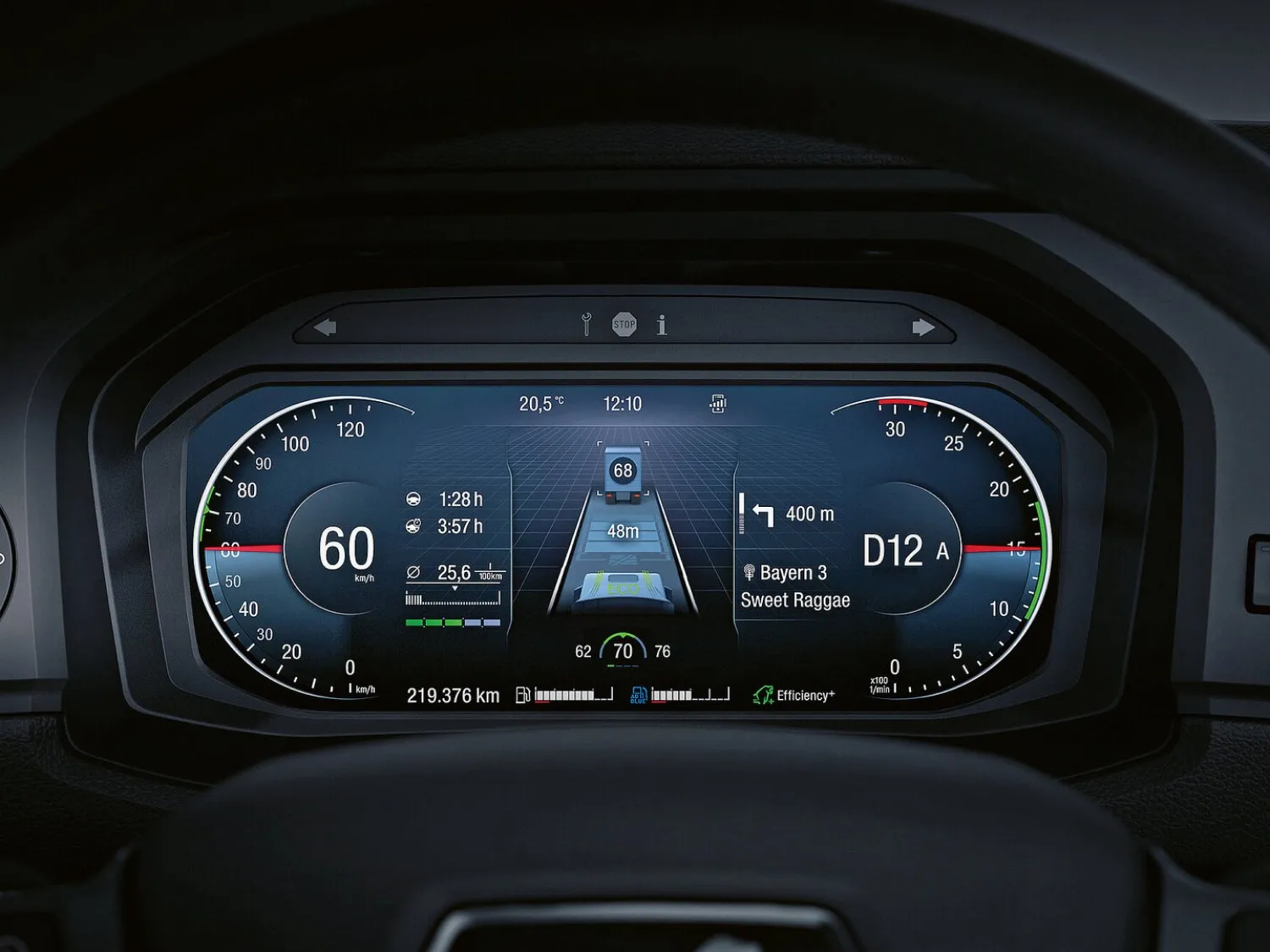
Cross-series UX lead for the digital cockpit of the 2020 truck generation: instrument cluster, driver assistance and vehicle error communication.
- Role
- UX concept lead, instrument cluster · ADAS · error communication
- Client
- MAN Truck & Bus
- Years
- 2017–2022
- Recognition
- ★ Red Dot Design Award
The Challenge
A long-haul driver spends more waking hours in that cab than most people spend in an office. The 2020 MAN truck generation rebuilt that workplace digitally: instrument cluster, driver-assistance systems, and every message the vehicle sends to the person operating it.
Every piece of information competes for the attention of someone who must not stop looking at the road. What separates commercial-vehicle HMI from consumer product design is that the user cannot opt out. A driver cannot close the app. Whatever the cluster says, at whatever moment it says it, is what they get.
I held this across series rather than for one vehicle, which meant every decision had to hold for current and future assistance systems, including highly automated driving, and had to be specified tightly enough for suppliers to build.
Key Decisions
- 01
Designed error communication as one system, not hundreds of messages
- Considered
- Treating each of the hundreds of possible vehicle faults as its own message, written by whoever owned that function.
- Chose
- A single grammar applied to every fault: what happened, how bad it is, what to do now.
Hundreds of individually reasonable messages add up to an incoherent vehicle. One structure, applied everywhere, is what makes a fault legible at a glance to a driver who has seen it for the first time at 80 km/h.
- 02
Answered the automation question before the driver asks it
- Considered
- Surfacing assistance status on change, or when the driver goes looking for it.
- Chose
- Continuous legibility of what the vehicle is doing right now and what the driver is still responsible for.
As automation increases, the driver’s most important question stops being “how fast am I going” and becomes “what is the vehicle doing, and what is still mine”. A question that important should not require an action to answer.
- 03
Treated the specification as the deliverable
- Considered
- Handing over visual designs and reviewing what the supplier built afterwards.
- Chose
- Wireframes, flowcharts and state diagrams precise enough to implement without interpretation.
In this domain an ambiguous specification does not become a design debate. It becomes a wrong behaviour in a shipped vehicle, discovered by a driver.
The Solution
Cross-series ownership of the instrument-cluster concept, the driver-assistance and automated-driving HMI, and vehicle error communication. Concept development coordinated across software, management, function development and sales, with documentation and coordination for software implementation, and supplier support throughout.
Delivered as information architecture, state diagrams and supplier-ready specification.
The Results
Red Dot Design Award for the digital cockpit of the 2020 truck generation.
The concept work rested on user studies run on a driving simulator, the same method as my master’s thesis on display and operating concepts in commercial vehicles, so the cluster decisions were tested against driver behaviour rather than argued from preference.